
 HELP ME PLAN

 HELP ME PLAN
Ngorongoro Crater Safari Guide — Everything You Need to Know in 2026
The Ngorongoro Crater is the world’s largest intact, unflooded volcanic caldera — a natural amphitheatre roughly 260 km² in area and 610 metres deep, sheltering some of Africa’s most concentrated wildlife populations entirely within its walls. Located in northern Tanzania as part of the Ngorongoro Conservation Area (a UNESCO World Heritage Site), it offers the rarest combination in African safaris: a self-contained ecosystem where the Big Five, including the critically scarce black rhino, roam year-round without seasonal migration out of reach.
- The Ngorongoro Crater is the world’s largest intact volcanic caldera — ~260 km² floor, 610 m deep — forming a natural wildlife enclosure in northern Tanzania.
- It holds one of Tanzania’s only reliable black rhino populations (a small, protected population), alongside lion, leopard, elephant, and buffalo — true Big Five in a compact area.
- UNESCO designates Ngorongoro as having the highest density of mammalian predators and the densest lion concentration in Africa.
- Most animals are resident year-round — unlike the Serengeti’s seasonal migration, game viewing inside the crater is consistently exceptional in every month.
- The crater is part of the broader Ngorongoro Conservation Area (8,300 km²), which also includes the Olduvai Gorge, one of the world’s most important palaeontology sites.
- Ngorongoro pairs naturally with the Serengeti and Maasai Mara on Tanzania’s northern safari circuit — most itineraries combine both.
What Exactly Is the Ngorongoro Crater?
The Ngorongoro Crater is a volcanic caldera — not a crater in the meteorite sense, but the collapsed remnant of a volcano that fell inward roughly 2–3 million years ago. The result is a near-perfect bowl: walls rising 400–610 metres above the floor, enclosing approximately 260 square kilometres of open grassland, forest, swamp, and a soda lake. It is the world’s largest intact, unflooded caldera of its kind — meaning the walls are continuous and unbroken, unlike eroded calderas elsewhere in Africa.
The crater sits within the broader Ngorongoro Conservation Area (NCA), a protected zone of roughly 8,300 km² in northern Tanzania’s Crater Highlands. The NCA is a unique conservation model: it is the only place in Tanzania where the Maasai people live alongside wildlife — cattle graze the crater rim and surrounding highlands, while the floor itself is reserved for wildlife. This co-existence has been maintained since 1959, when the Maasai were relocated from the Serengeti to allow that park to be gazetted; in recognition, the NCA was set aside as shared land.
The NCA was inscribed as a UNESCO World Heritage Site in 1979, recognised for its outstanding natural landscape, its extraordinary wildlife density, and the Olduvai Gorge — the site where palaeontologist Louis Leakey uncovered fossil evidence of some of the earliest human ancestors, making Ngorongoro one of the most palaeontologically significant places on Earth.
What Wildlife Will You See in the Ngorongoro Crater?
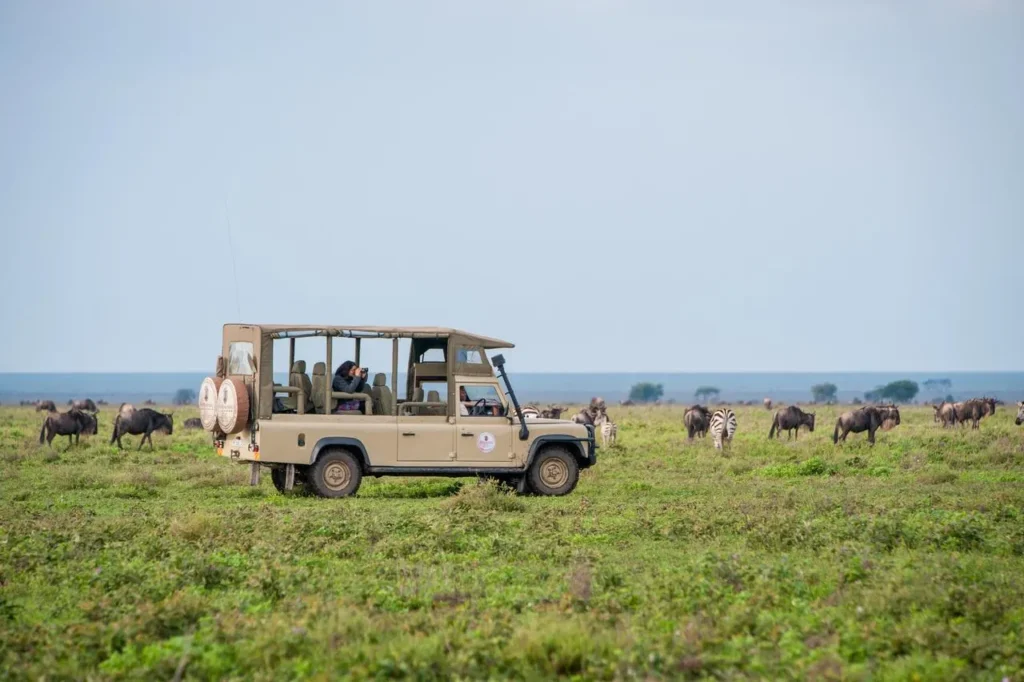
The crater floor supports an estimated 25,000–30,000 large mammals at any given time, making it one of the densest wildlife concentrations on the continent. Because most animals are resident year-round — held within the caldera’s walls by instinct, water, and pasture — there is no “bad month” for a Ngorongoro safari.
The Big Five in the crater:
- Lion — Ngorongoro has one of Africa’s highest lion densities. UNESCO documents it as the densest lion concentration in Africa. The crater’s prides are well-habituated to vehicles and frequently sighted at kills.
- Black Rhino — With an estimated ~26 individuals, Ngorongoro’s black rhino population is among the most reliably viewable in Tanzania. This is one of very few places where a Tanzania safari visitor stands a genuine chance of spotting this critically endangered species.
- Elephant — The crater holds a resident elephant population. Notably, the bulls inside the crater are known for their impressive tusks; Ngorongoro is one of the few areas where large-tusked “big tusker” elephants are still regularly encountered.
- Buffalo — Large herds of Cape buffalo are year-round fixtures on the crater floor, particularly around the Lerai Forest and the Ngoitokitok spring.
- Leopard — Less frequently sighted than other Big Five, but present. The forested crater walls and Lerai Forest offer leopard habitat; patient early-morning drives yield the best sightings.
Other signature species:
- Spotted hyena — The crater’s hyena clans are among the most studied in the world; active hunts at dawn are a common spectacle.
- Cheetah — Visible on the open short-grass plains of the crater floor, though numbers are lower than the Serengeti.
- Golden jackal and black-backed jackal — Both species are common and frequently seen scavenging around kills.
- Hippopotamus — Resident in the Mandusi Hippo Pool, one of the crater’s reliable water features.
- Flamingo — Lake Magadi, the soda lake at the crater’s centre, draws flamingo flocks during certain seasons.
- Wildebeest and zebra — Large herds graze the short-grass plains, though unlike the Serengeti population these animals rarely leave the crater.
Bird diversity is exceptional: over 500 bird species have been recorded in the NCA, including the crowned crane (Tanzania’s national bird), kori bustard, secretary bird, and numerous raptors including the martial eagle and augur buzzard.
When Is the Best Time to Visit Ngorongoro Crater?
Unlike seasonal migration destinations, the Ngorongoro Crater offers excellent wildlife viewing every month of the year. However, season does affect conditions meaningfully:
| Season | Months | Conditions | Wildlife Highlights |
|---|---|---|---|
| Dry season | June–October | Cool, clear skies; dusty crater floor; best road conditions | Animals concentrate at water sources; predator activity high; no rain interruptions |
| Short rains | November–December | Brief afternoon showers; crater floor lush and green | Migratory birds arrive; calving season begins; fewer tourists |
| Green season | January–March | Warm and lush; occasional morning mist in the crater | Wildebeest calving on nearby plains; exceptional birdlife; lower lodge rates |
| Long rains | April–May | Heaviest rainfall; some roads on crater floor can become difficult | Quietest period; dramatic light for photography; lowest lodge rates |
Peak visitor months are July–September (Northern Hemisphere summer holidays), when the Ngorongoro–Serengeti circuit is at its busiest. Booking 6–12 months in advance for these months is strongly advised for the best crater-rim lodge options.
The early morning descent into the crater is universally recommended: mist lifts off the walls at sunrise, predators are active after nocturnal hunts, and vehicle numbers are lower before the midday influx. Most crater-floor permits require exit by 6:00 PM.
Where Do You Stay for a Ngorongoro Crater Safari?
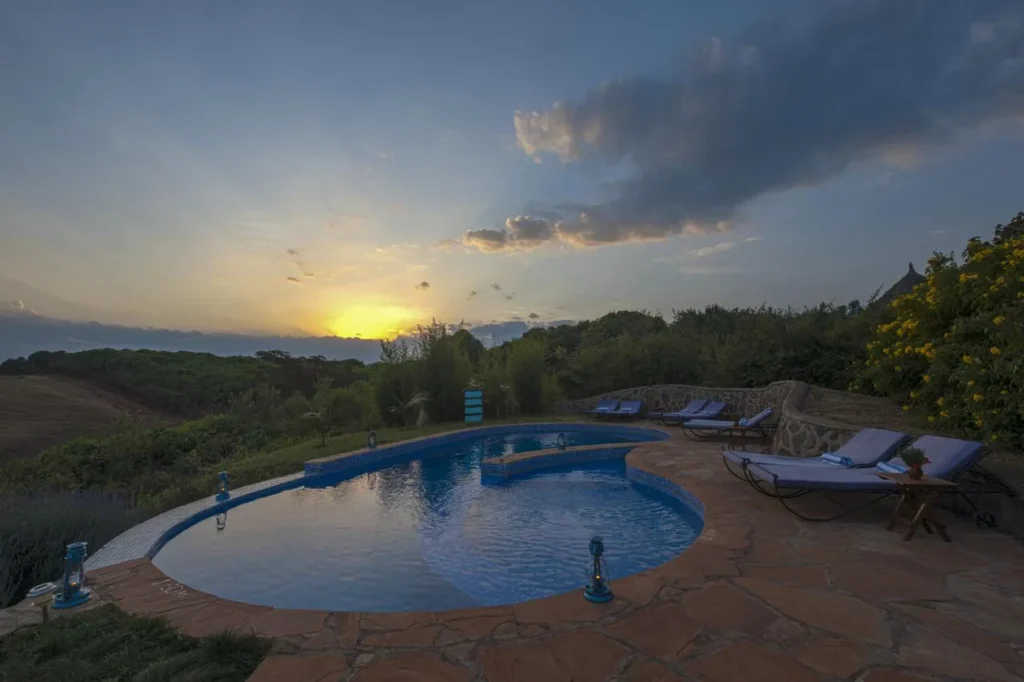
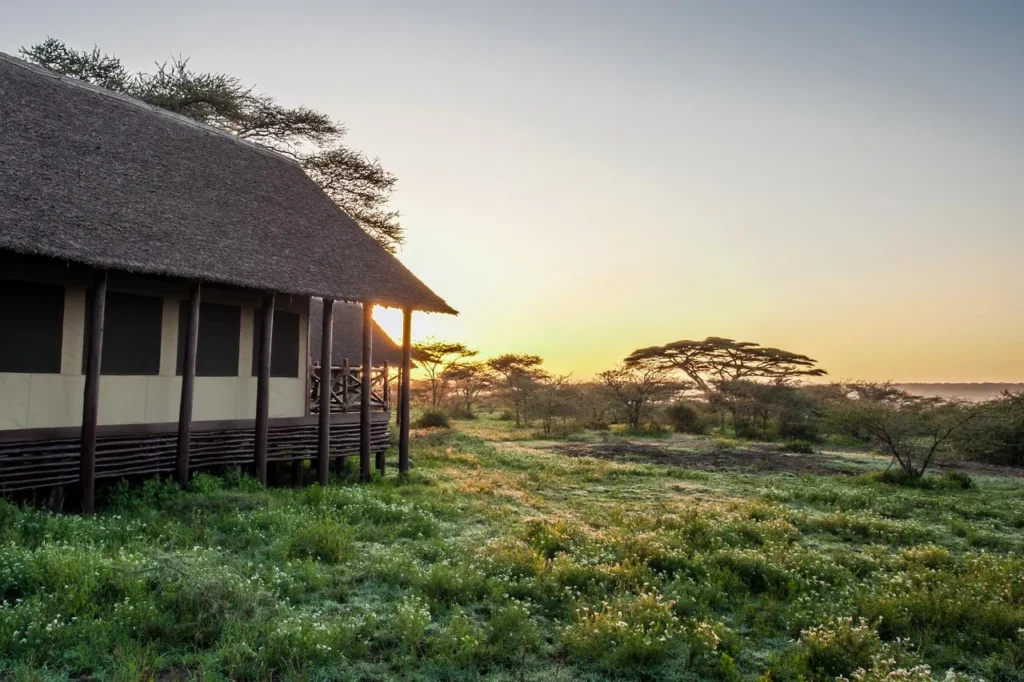
Accommodation in the Ngorongoro area broadly falls into two categories: crater-rim lodges (perched above the caldera with views into the crater) and highland lodges in the surrounding conservation area. There is no permanent accommodation on the crater floor itself — all visitors descend daily.
Crater-rim position matters enormously: lodges on the inner rim look directly down into the caldera, with sunrise views across the floor. On cold mornings (the rim sits at approximately 2,200–2,400 m altitude), this is one of the most dramatic breakfast settings in African travel.
Key lodge tiers to understand:
- Ultra-luxury crater-rim — A small number of lodges offer suites with private decks directly overlooking the crater. These represent the pinnacle of the Ngorongoro experience and carry premium tariffs. Early booking is essential.
- Classic crater-rim — Established lodges with comfortable rooms, communal crater-view areas, and reliable service. Strong value for the experience.
- Highland/NCA camps — Mobile or semi-permanent camps within the conservation area, away from the crater rim. Better suited to combination itineraries covering the Serengeti and the Olduvai Gorge.
For specific current availability and rates across all Ngorongoro crater-rim and highland lodges, a specialist operator with direct Tanzania lodge relationships can provide options matched to travel dates, group size, and budget — including exclusive-use configurations for families or private travel.
How Do You Get to Ngorongoro Crater?
Ngorongoro is most commonly accessed as part of Tanzania’s northern safari circuit, which connects Arusha, Tarangire, the Serengeti, and Ngorongoro in a logical loop.
By air:
- Kilimanjaro International Airport (JRO) — The primary gateway, served by major international carriers with connections through Nairobi, Addis Ababa, Doha, Amsterdam, and London. From Kilimanjaro, Arusha is approximately 45 minutes by road.
- Arusha Airport (ARK) — Handles charter and light aircraft. A short hop from Kilimanjaro for those continuing by road to the crater.
- Light aircraft charters from Arusha to Lake Manyara airstrip or Seronera (Serengeti) are a faster alternative to the road transfer; typical flight time is approximately 45 minutes.
By road:
- Arusha to the Ngorongoro Crater rim is approximately 180 km — roughly a 3–4 hour drive on a good road through the Rift Valley escarpment and the town of Mto wa Mbu.
- The drive passes Lake Manyara National Park — many itineraries include a game drive here en route, extending the journey comfortably to a full day.
Within the crater:
Access to the crater floor is managed by the Ngorongoro Conservation Area Authority. Only authorised 4WD safari vehicles are permitted to descend, and permits are required. The descent road is steep and takes approximately 20–30 minutes to the floor. Day visitor permits are issued per vehicle; your operator handles all permit logistics.
What Is the Olduvai Gorge and Why Does It Matter?
Located approximately 45 km west of the Ngorongoro Crater, within the same Conservation Area, the Olduvai Gorge is one of the world’s most important archaeological sites. Here, palaeontologist Louis Leakey and his wife Mary Leakey made a series of landmark discoveries from the 1950s onwards, uncovering fossilised hominid bones dating back approximately 1.8 million years — providing critical evidence for the “Out of Africa” theory of human evolution.
Olduvai is a natural erosion gorge cutting 90 metres into the plains — exposing geological strata that effectively form a record of early human life on Earth. A small but excellent on-site museum contextualises the discoveries, and guided visits take approximately 1–2 hours. Most northern circuit itineraries include a half-day stop at Olduvai en route between the crater and the Serengeti.
Visiting both the crater and Olduvai in the same trip gives a Ngorongoro safari an additional dimension few Africa destinations can offer: extraordinary wildlife alongside the literal birthplace of humankind.
How Does Ngorongoro Compare to the Serengeti?
Ngorongoro and the Serengeti are complementary, not competing destinations — and most Tanzania itineraries include both. Understanding the differences helps set expectations:
| Factor | Ngorongoro Crater | Serengeti National Park |
|---|---|---|
| Area | 260 km² (crater floor) | 14,763 km² |
| Wildlife density | Exceptionally high — contained ecosystem | Varies by zone and season |
| Black rhino | ✅ ~26 resident; most reliable in Tanzania | ❌ Effectively absent |
| Great Migration | ❌ Small resident herds only | ✅ 1.5 million wildebeest annual circuit |
| Game drive style | Concentrated; half-day or full-day crater descent | Open plains; multi-day roaming drives |
| Accommodation | Crater-rim lodges; daily descent only | In-park tented camps; sleep inside the ecosystem |
| UNESCO status | World Heritage Site | World Heritage Site |
| Altitude | Rim: ~2,200 m; floor: ~1,600 m | ~920–1,850 m |
| Best for | Excellent wildlife viewing, including opportunities to see black rhino | Great Migration; big predator territories; open horizons |
A well-structured Tanzania itinerary typically spends 1–2 nights on the Ngorongoro rim and 3–5 nights in the Serengeti, with the ratio adjusted based on the Great Migration’s position during the travel dates.
Is Ngorongoro Crater Safe for Families?
Ngorongoro is a good family safari destination, though a few practical points apply:
- Malaria: Malaria is present in the Ngorongoro area. Consult your doctor 6–8 weeks before travel about appropriate prophylaxis. The crater floor, being at higher altitude than most Tanzania safari zones, carries lower transmission risk — but the surrounding NCA and Serengeti are standard malarial zones.
- Children’s age: Most crater-rim lodges do not have minimum age restrictions, though the long game drives and early mornings suit children aged 6 and above more comfortably. Some exclusive-use lodges will accept all ages.
- Altitude: The crater rim sits at approximately 2,200–2,400 metres. Most visitors notice nothing, but those sensitive to altitude may want a day to acclimatise after arriving from sea level.
- Vehicle access: Only 4WD vehicles are used on the crater floor; your operator will provide appropriate, vetted vehicles. All crater descents require permit documentation — handled by a reputable operator.
Frequently Asked Questions About Ngorongoro Crater Safaris
What is the Ngorongoro Crater, and why is it special?
The Ngorongoro Crater is the world’s largest intact, unflooded volcanic caldera — a natural bowl approximately 260 km² in area and 610 metres deep in northern Tanzania. It holds an extraordinary concentration of resident wildlife, including the Big Five and one of Tanzania’s only reliable black rhino populations (~26 individuals). UNESCO recognises it as having the highest density of mammalian predators in Africa and the densest lion concentration on the continent. It is part of the Ngorongoro Conservation Area, a UNESCO World Heritage Site inscribed in 1979.
Can you see the Big Five in Ngorongoro Crater?
Yes — All five occur, but sightings are not guaranteed. Lion, elephant and buffalo are regularly seen; black rhino are a particular highlight, while leopard sightings are less common. Ngorongoro is particularly distinguished for black rhino: with approximately 26 resident individuals, it offers one of the best chances in Tanzania to see this critically endangered species. The crater’s resident wildlife population — estimated at 25,000–30,000 large mammals — means Big Five encounters are consistently achievable regardless of season.
What is the best time of year to visit Ngorongoro Crater?
Game viewing is excellent year-round because most animals are permanent residents inside the caldera. The dry season (June–October) offers cooler temperatures, clear visibility, and the highest concentration of animals at water sources. The green season (November–March) brings lush scenery, fewer vehicles, and lower lodge rates — often the best value period for experienced safari-goers. April–May (long rains) is the quietest period and delivers the lowest rates of the year.
How long should you spend at Ngorongoro Crater?
A minimum of 1 full day in the crater (one full-day or two half-day descents) is recommended, requiring at least 2 nights on the crater rim. Most itinerary specialists recommend 2 nights minimum to allow one early-morning descent and one full-day descent, covering different areas of the floor. Ngorongoro is typically combined with the Serengeti (3–5 nights) and often Lake Manyara or Tarangire for a complete northern Tanzania circuit.
Is there accommodation inside the Ngorongoro Crater?
There is no permanent accommodation on the crater floor. All visitors stay in lodges on the crater rim or in the surrounding conservation area and make daily descents by 4WD. The crater-rim lodges offer dramatic elevated views directly into the caldera; ultra-luxury options include private suites with crater-facing terraces. The descent road to the floor takes approximately 20–30 minutes, and the crater floor must be exited by 6:00 PM daily.
How much does a Ngorongoro Crater safari cost?
Costs vary significantly by lodge tier, time of year, and itinerary length. Crater-rim lodges range from mid-market properties (approximately USD 400–700 per person per night) to ultra-luxury crater-rim suites (USD 1,500–2,500+ per person per night) during peak season. These figures typically include accommodation, meals, and guiding but exclude the Ngorongoro Conservation Area entry fees and crater descent permits (budgeted separately). A full Tanzania northern circuit itinerary combining Ngorongoro and the Serengeti ranges from approximately USD 5,000–12,000+ per person for 7–10 nights depending on lodge selection. Request a tailored quote from a specialist with current ground operator relationships for accurate 2026 pricing.
What is the Olduvai Gorge and should I visit it?
The Olduvai Gorge (also spelled Oldupai) is located approximately 45 km from the Ngorongoro Crater within the same conservation area. It is one of the world’s most important palaeontological sites — where Louis and Mary Leakey discovered hominid fossils dating back 1.8 million years, providing key evidence for human evolution in Africa. A guided museum visit takes 1–2 hours and is typically included in crater-to-Serengeti road transfers. It is highly recommended: few places on Earth combine extraordinary wildlife with the literal site of early human origins.
Do I need a visa to visit Tanzania?
Most nationalities require a tourist visa for Tanzania. As of 2026, Tanzania operates an e-visa system via the Tanzania Immigration Services portal, with processing typically completed within 2–5 working days. Citizens of East African Community member states are exempt. Entry requirements can change: verify current requirements with the Tanzanian High Commission or your specialist operator at the time of booking. Additionally, proof of yellow fever vaccination may be required depending on your country of departure — check the current requirements when planning your trip.
Plan Your Ngorongoro Crater Safari in 2026
The Ngorongoro Crater is one of Africa’s genuinely unmissable destinations — a place where the geology, the wildlife density, and the human history converge in a way no other location on the continent can replicate. Planning the right combination of lodges, crater descent timing, and circuit itinerary makes the difference between a good safari and an extraordinary one. African Safari Group (ASG), a specialist luxury safari operator with established relationships across Tanzania’s northern circuit lodges, can tailor a Ngorongoro itinerary matched exactly to your travel dates, group size, and interests. Enquire now to start planning your 2026 or 2027 Ngorongoro Crater safari.
Recent Comments